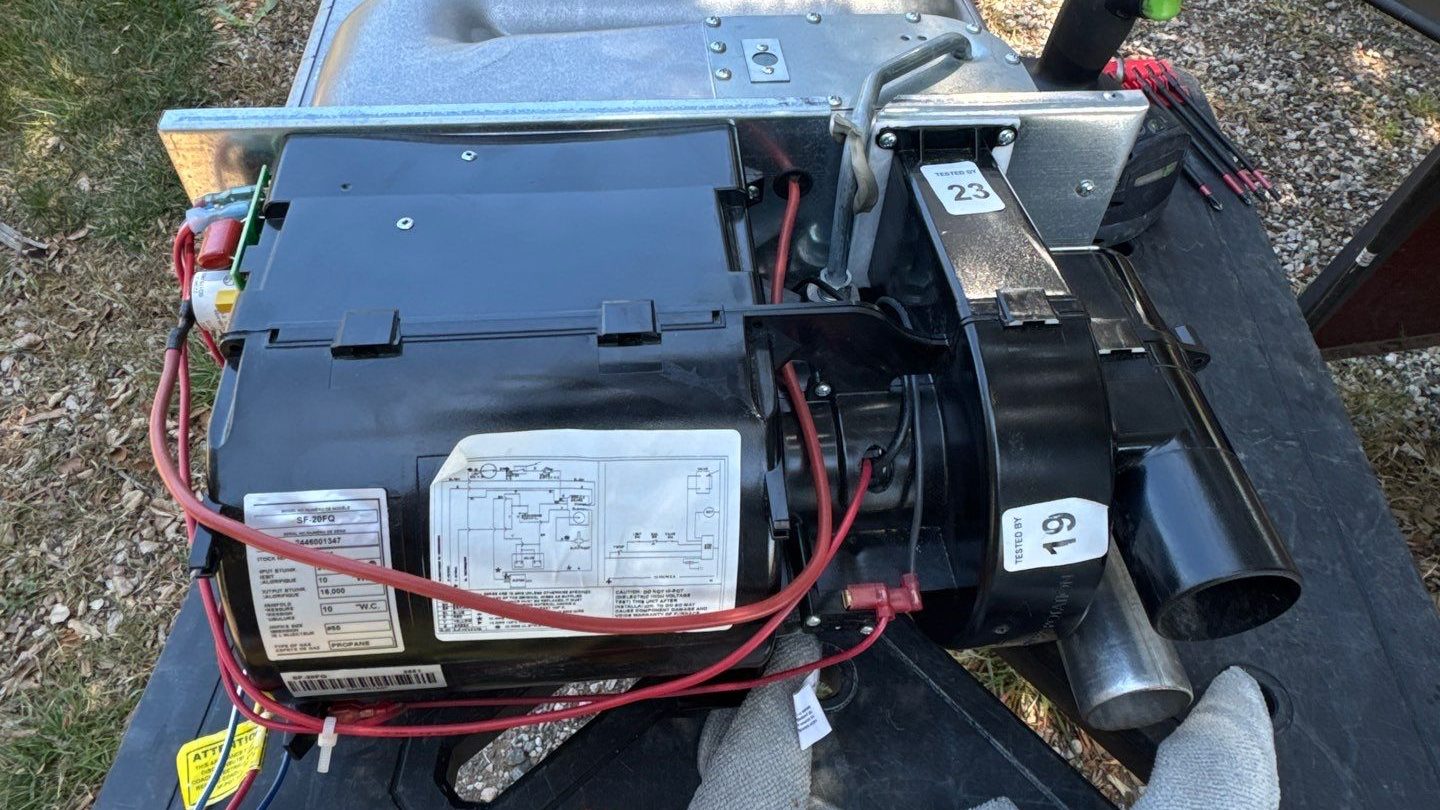
A real one from a recent job — an RV furnace out on the bench for service. Most "no heat" calls, though, start with a few things you can check yourself in minutes.
There are few things less welcome than a cold night in the RV and a furnace that just won't light. The good news: a surprising number of "no heat" calls come down to something simple you can check yourself in a few minutes. Here's how to walk through it safely — and how to know when it's time to hand it to a tech.
1. Make sure the thermostat is calling for heat
Set it to Furnace/Heat — not just the fan, and not the air conditioner's electric heat strip — put the fan on Auto, and bump the temperature several degrees above the current room temperature. Listen closely: you should hear the blower kick on within a few seconds. If nothing happens at all, the problem is upstream of the furnace itself.
2. Check your 12-volt battery
This one trips a lot of people up. Your furnace runs its blower and control board on 12-volt DC power even when you're plugged into shore power. If the house battery is low, the blower can't spin up to the speed it needs to trigger ignition — so the furnace either won't start or fires up and quits. Make sure the battery is charged and the connections are clean and tight.
3. Confirm propane is flowing
Check that the tank isn't empty and the valve is fully open, then test another propane appliance — if your stovetop lights normally, you've got gas to the RV. If you just refilled after running the tank dry, there may be air in the line; running a stove burner for a minute or two usually clears it.
4. Clear the airflow — inside and out
Your furnace has a safety switch (the "sail switch") that won't allow ignition unless the blower is moving enough air. Inside, make sure return-air grilles and floor or wall vents are clear. Outside, check the furnace's exterior intake and exhaust vents — mud dauber nests, spider webs, and debris packed into those little ports are one of the most common no-ignition causes we see. Gently clearing the outside vents is owner-safe.
5. Listen to the startup sequence
A healthy furnace goes: thermostat calls → blower runs 15–30 seconds → a click as the igniter and gas valve fire → flame and warm air. Where it stops tells the story. No blower at all points toward the battery, fuse, or thermostat. Blower runs but you never get the click-and-flame points toward the gas side.
6. Reset it and check the fuse
Turn the thermostat all the way off, wait 30 seconds, then cycle it back to heat — furnaces "lock out" after a couple of failed attempts and often just need a reset. While you're there, check the furnace's DC fuse in your 12-volt fuse panel. A blown fuse is a cheap, common fix.
One hard safety rule
If you ever smell gas — that rotten-egg odor — stop right there. Shut the propane off at the tank, get everyone out, don't flip switches or light anything, and don't try to troubleshoot it. A suspected gas leak is never a DIY job. Call us or your propane supplier right away.
When it's time to call a pro
Reach out if the blower runs but you never get that click-and-flame; the furnace keeps locking out or lights and then quickly shuts off; the blower won't start at all even with a good battery and fuse; you see soot or a yellow instead of blue flame; or the fix means opening the gas train, burner tube, orifice, sail switch, or control board. Those all live on the combustion and gas-supply side of the furnace — tech territory, both for your safety and to avoid chasing the wrong part.
Still no heat? We come to you.
Serving all of Santa Barbara County — Santa Barbara, Goleta, Montecito, Carpinteria, and the Santa Ynez Valley. Start with a free phone consultation and we'll help you figure out whether it's a quick fix or a service call.
Get a Free Estimate Call 833-RVTECH-4